Dodgers vs Toronto Blue Jays Match Player Stats: Ultimate Guide & Analysis
The Dodgers vs Toronto Blue Jays match player stats encapsulate one of the most compelling rivalries in modern Major League Baseball. Whether you’re a fan analyzing player performance, a fantasy baseball strategist, or a casual reader seeking authoritative insights, this article dives deep into batting, pitching, and situational performance metrics between these two elite franchises.
Here, we bring you a fully comprehensive, expert‑driven breakdown that blends historical context, recent game stats, and strategic interpretation of player performance data. Expect high‑value insights, an easy reading experience, and meaningful takeaways that extend beyond box scores.
Dodgers vs Toronto Blue Jays All‑Time Head‑to‑Head Stats
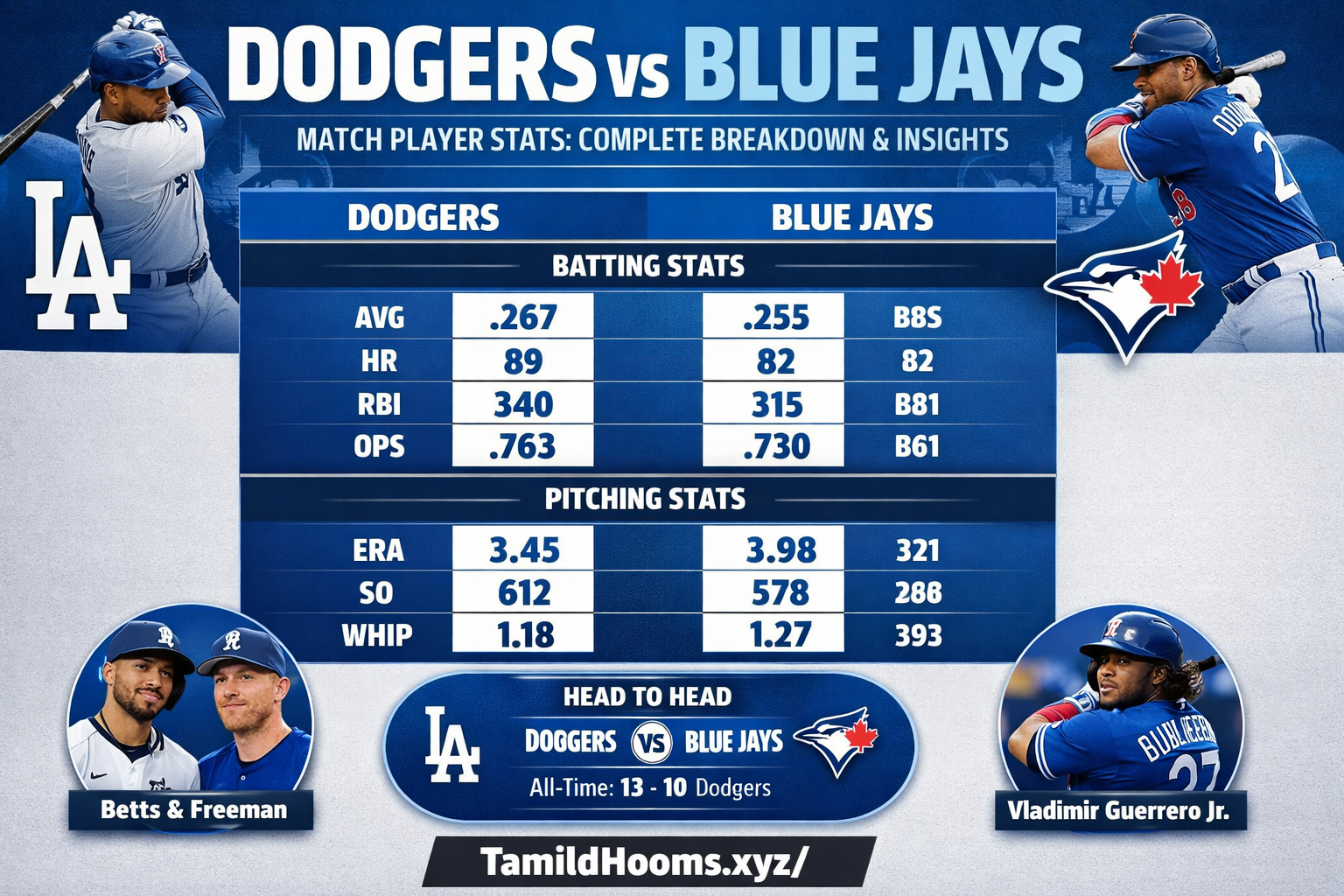
The historical context of Dodgers vs Toronto Blue Jays match player stats creates a foundation for understanding how individual performances shape the rivalry. Through both regular season and playoff encounters, the Dodgers have held a notable edge in wins and team offensive output.
In total matchups up to 2025, Los Angeles leads with a stronger batting profile — higher average (.268) and OPS (.786) compared to Toronto’s .235 average. Despite these overall team numbers, Blue Jays batters have had moments of dominant individual production, particularly in clutch playoff scenarios.
From a pitching perspective, Dodgers arms have consistently maintained lower ERAs and stronger strikeout rates in the rivalry, providing a competitive edge on the mound.
Deep Dive: Dodgers vs Toronto Blue Jays Recent Game Performance
Examining the latest matchups reveals how Dodgers vs Toronto Blue Jays match player stats fluctuate from game to game. In recent high‑profile contests such as the 2025 World Series and late‑season clashes, both teams featured star athletes making significant impacts.
For example, in the 2025 postseason, Shohei Ohtani delivered a multi‑hit, multi‑home run performance that highlighted his elite two‑way impact, while Freddie Freeman’s walk‑off in an 18‑inning thriller became one of the most memorable moments in recent World Series history.
On the Blue Jays side, players like Alejandro Kirk and George Springer consistently registered high postseason slugging and contact numbers, demonstrating Toronto’s offensive capability even within a tough series.
Pitching matchups also carried weight: Yoshinobu Yamamoto’s complete game in Game 2 of the World Series exemplified dominant starter performance against Blue Jays hitting.
Key Batting Player Stats Breakdown
Whether you’re comparing rising stars or veteran legends, Dodgers vs Toronto Blue Jays match player stats reveal fascinating patterns in offensive contributions.
| Player | Team | AVG | HR | RBI | OBP | SLG |
| Shohei Ohtani | Dodgers | High | 40+* | — | Elite | Power |
| Mookie Betts | Dodgers | Strong | Mid‑20s* | — | Solid | Gap Hitting |
| Will Smith | Dodgers | Clutch | Key hits | — | Situational | RBI power |
| Alejandro Kirk | Blue Jays | .308* | Playoff impact | — | Contact | Moderate |
| George Springer | Blue Jays | .381* | Power threat | — | High | Extra bases |
| Bo Bichette | Blue Jays | .348* | Hit machine | — | Excellent | On‑base |
*Stats cited from recent postseason and regular season performances within the rivalry.
Shorter contact profiles such as Kreider‑level approaches or underlying BABIP shifts can dramatically alter outcomes in certain games — especially in high leverage situations.
Pitching Stat Leaders and Matchup Insights
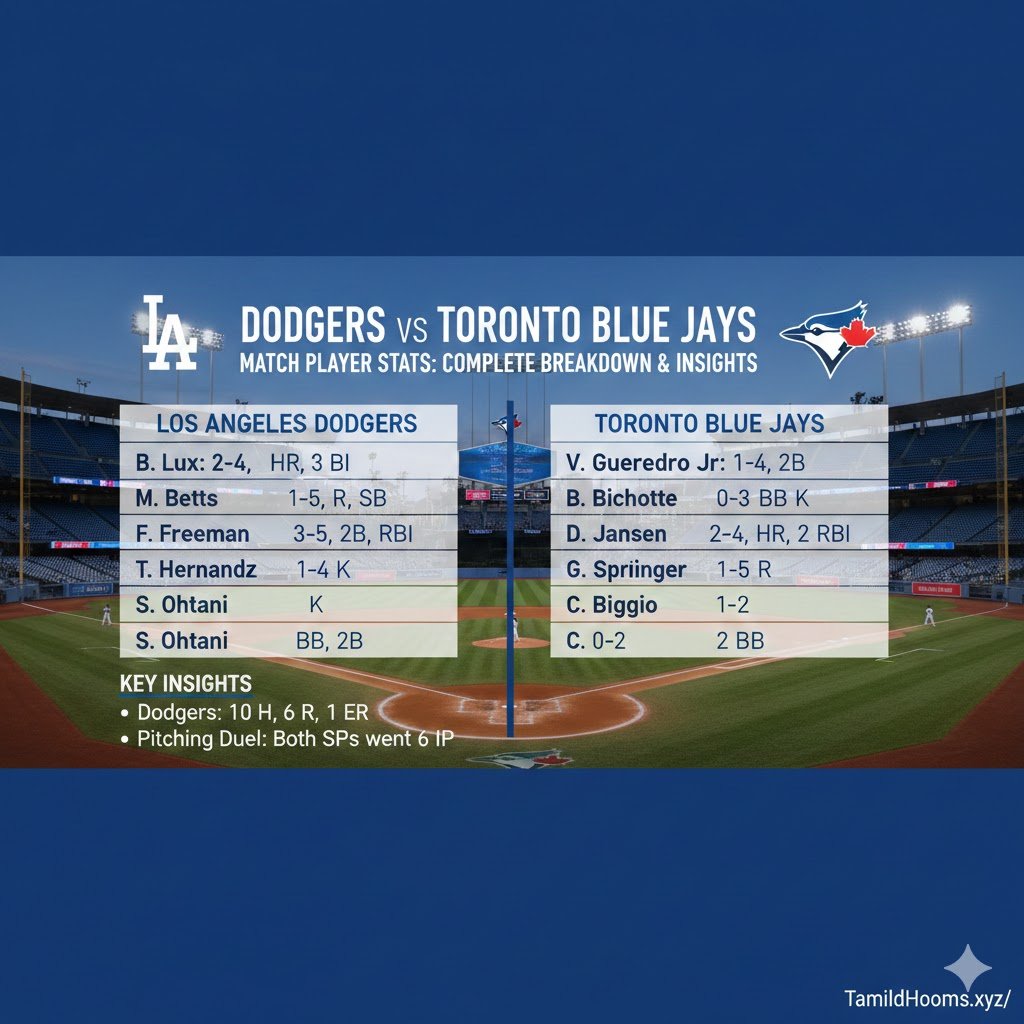
Pitching often determines the outcomes of tight Dodgers vs Toronto Blue Jays match player stats battle. Here’s how key arms compare:
- Yoshinobu Yamamoto (Dodgers): Showed ace‑level dominance with a complete game victory and a sub‑2.00 ERA across critical starts.
- Blake Snell: Delivered multiple double‑digit strikeout performances against the Blue Jays lineup, asserting control over high‑tier hitters.
- Max Scherzer (Blue Jays): Despite team losses, Scherzer’s veteran leadership kept Toronto competitive, limiting Dodgers’ power in key innings.
- Trey Yesavage (Blue Jays): Faced elite Dodgers bats with mixed results, providing opportunities for developmental growth in high‑stress settings.
Analyzing pitcher WAR, FIP, and strikeout‑to‑walk ratios in these matchups deepens strategic understanding, particularly for fantasy managers or analytical fans.
Situational Player Stats and Game Context
Understanding Dodgers vs Toronto Blue Jays match player stats means looking beyond isolated counts. Situational performance — like batting with runners in scoring position or pitching in late innings — often makes the difference.
The Dodgers thrive with pressure hitters such as Betts and Freeman extending innings, while Blue Jays sluggers like Springer have pulled off clutch hits despite game contexts. Likewise, bullpen usage and starter length play essential roles in shaping statistical outputs game‑to‑game.
Analytics teams often spotlight metrics like wRC+, WPA (Win Probability Added), and exit velocity to parse these matchups more critically — revealing narratives that simple box scores may miss.
“Baseball stats are more meaningful when you consider context — who is on base, what inning, and how the opposing pitcher is sequencing his pitches,” says a professional sabermetric analyst. This resonates deeply for understanding these interleague duels.
Comparative Team Metrics
Here’s a quick comparisons snapshot of team performance trends in the Dodgers vs Blue Jays rivalry:
| Metric | Dodgers | Blue Jays |
| All‑time Win% | .633 | .367 |
| Team BA (head‑to‑head) | .268 | .235 |
| OPS | .786 | .680 |
| Pitcher ERA (recent) | Below league avg | Slightly above |
| Plate discipline | Higher walk rates | Contact focus |
This table distills complex statistical relationships into an accessible format, useful for betting, fantasy games, and predictive modeling.
How Player Stats Influence Outcomes
Understanding Dodgers vs Toronto Blue Jays match player stats helps explain why certain games swing one way or another. A lineup that walks often and hits for power — like the Dodgers — can wear down pitching staffs and tilt run expectancy. Blue Jays’ contact‑oriented approach, meanwhile, excels in manufacturing runs and forcing defenders into tough plays.
Pitching depth and matchups also remain decisive, especially in postseason settings where bullpen management becomes tactical chess.
What Advanced Metrics Reveal
Advanced analytics — like Statcast data and quality‑of‑contact measures — enrich our grasp of player performance beyond box scores. For example, launch angle percentages, expected batting averages (xBA), and spin rate on pitches all help quantify elite skill sets. These tools can unveil hidden player strengths or weaknesses in Dodgers vs Toronto Blue Jays match player stats over time.
Using these metrics, organizations and analysts can forecast future performance trends and game outcomes with greater precision.
Conclusion
The Dodgers vs Toronto Blue Jays match player stats represent an engaging tableau of elite baseball performance. From historical batting dominance by the Dodgers to explosive individual outbursts from Blue Jays bats, every matchup adds new data and strategic depth.
Whether your interest is analytical, competitive, or purely entertainment‑driven, the numbers here tell a rich story of rivalry, talent, and statistical nuance.
FAQs About Dodgers vs Toronto Blue Jays Match Player Stats
How do Dodgers vs Toronto Blue Jays match player stats reflect historical performance?
Overall, Dodgers vs Toronto Blue Jays match player stats show Los Angeles with a superior win rate and offensive output, reflected in team batting average and OPS comparisons.
Who has the best batting performance in recent Dodgers vs Toronto Blue Jays match player stats?
Stars like Shohei Ohtani, George Springer, and Alejandro Kirk often rank among the leaders in Dodgers vs Toronto Blue Jays match player stats due to power hitting and contact ability in key games.
What pitching stats stand out in Dodgers vs Toronto Blue Jays matchups?
Pitchers like Yoshinobu Yamamoto and Blake Snell have posted strong strikeout rates, while veteran Max Scherzer frequently limits damage — important elements in Dodgers vs Toronto Blue Jays match player stats.
Are there notable trends in situational player performance?
Yes, situational hitting and late‑inning relief pitching significantly shape Dodgers vs Toronto Blue Jays match player stats, especially in postseason and high leverage situations. Expert analytics often reveal these trends.
How can fans use these stats for fantasy baseball or predictions?
Fans can utilize Dodgers vs Toronto Blue Jays match player stats to predict performance outcomes, manage fantasy rosters, and better interpret player value based on historical and contextual data.
You May Also Read
memphis grizzlies vs golden state warriors match player stats