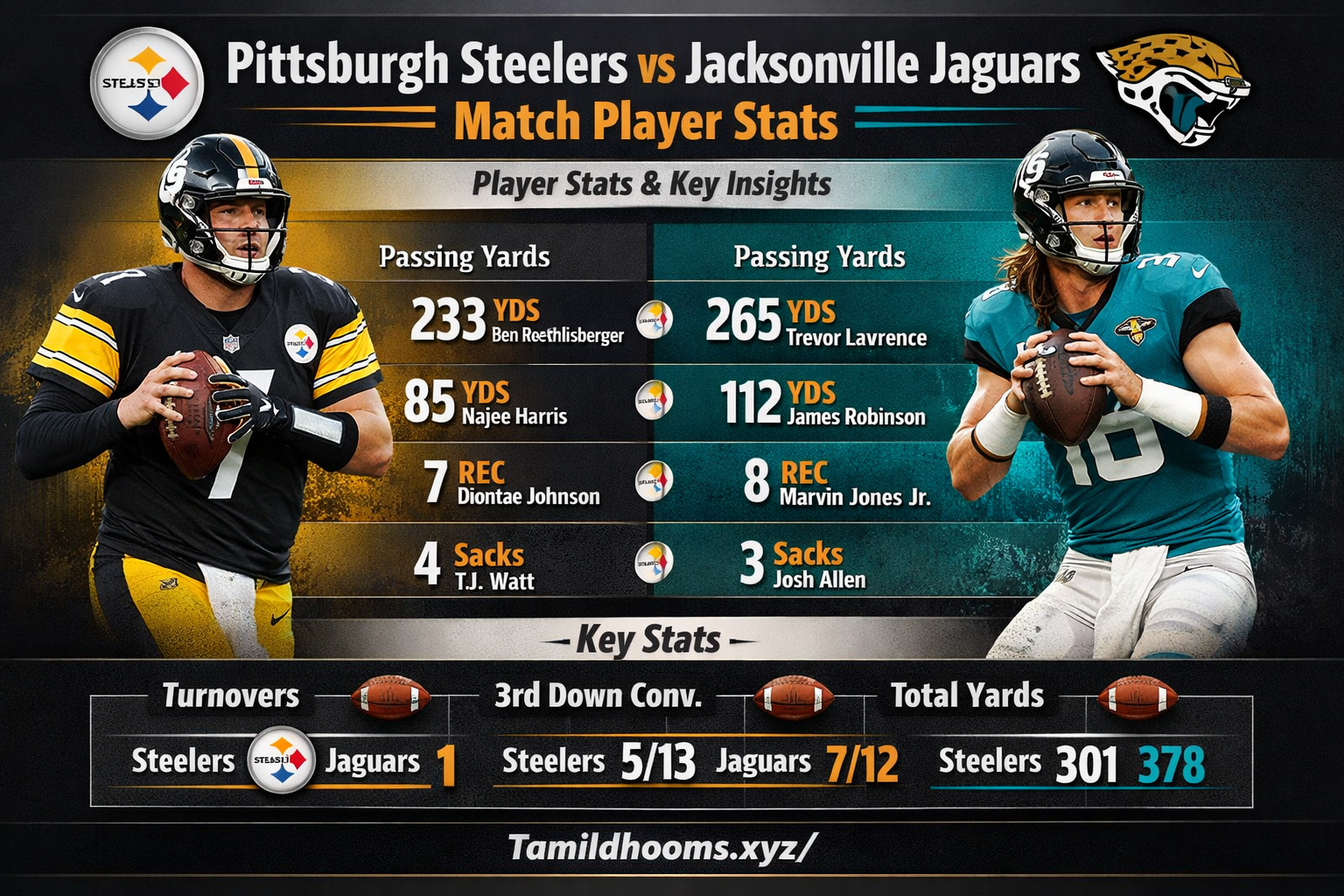
Pittsburgh Steelers vs Jacksonville Jaguars Match Player Stats: A Definitive Deep Dive
In the competitive world of the Pittsburgh Steelers vs Jacksonville Jaguars match player stats, every yard gained and every tackle made tells a story about strategy, execution, and individual performance. Whether you’re a die‑hard NFL fan, a fantasy football strategist, or a casual observer trying to unpack a matchup, this comprehensive article is your authority on the key player statistics and performance insights that defined the most recent clash between these two franchises.
In this expert breakdown, we go beyond the box score to deliver analytical clarity, context, and narrative depth on how each unit contributed and which players stood out. Drawing on official sources and game data, you’ll get thorough statistical tables, comparative analyses, expert quotes, and actionable takeaways — all structured to inform and engage both seasoned analysts and passionate supporters.
Offensive Standouts and Quarterback Performances
The first pillar of Pittsburgh Steelers vs Jacksonville Jaguars match player stats revolves around how each team moved the ball, controlled the tempo, and leveraged their offensive weapons. Quarterback play is always the heartbeat of any NFL matchup, and in this game, it offered clear contrasts.
Skylar Thompson spearheaded the Steelers’ aerial attack, completing 20 of 28 passes for 233 yards with three touchdowns and no interceptions, a standout performance that provided rhythm and scoring efficiency. On the Jaguars’ side, Nick Mullens delivered a more conservative outing, finishing 11 of 18 for 89 yards with one touchdown, reflecting a short‑to‑medium passing plan that kept drives alive without extending deep shots.
These quarterback metrics underscore how quarterback accuracy, decision‑making, and offensive design impact outcomes, especially in games where both teams rely on backup or rotational signal‑callers.
From an analytical perspective, understanding these passing dynamics — and how complementary running games (or the lack thereof) shaped opportunities — is essential to extracting meaning from the Pittsburgh Steelers vs Jacksonville Jaguars match player stats.
The Jaguars were creative in leveraging space through Trenton Irwin’s receiving skills, while Pittsburgh found efficiency with Ke’Shawn Williams, blending yards after catch with consistent route placement.
Rushing Leaders and Ground Attack Impact
While the passing game usually grabs the headlines, the ground attack often dictates game flow in tight matchups. Reviewing the Pittsburgh Steelers vs Jacksonville Jaguars match player stats shows that neither team dominated on the ground, but role players made meaningful contributions.
For the Steelers, Lew Nichols led rushing efforts with six carries for 31 yards, averaging 5.2 yards per attempt — a solid efficiency that helped sustain select drives. For Jacksonville, Bhayshul Tuten’s six carries generated 24 yards and a rushing touchdown, highlighting his ability to find seams and capitalize in short‑yardage situations.
These rushing metrics reflect how each coaching staff incorporated the run game to balance offensive pressures. Although the numbers were modest, strategic rushes help open passing lanes and force defenses to respect multiple threats.
In the broader context of Pittsburgh Steelers vs Jacksonville Jaguars match player stats, rushing success isn’t always about volume — it’s about impact. A high average per carry or a key rushing touchdown can swing momentum and impact play‑calling in critical phases of the game.
Receiving Leaders and Big‑Play Contributors
The receiving corps on both teams played pivotal roles in shaping the Pittsburgh Steelers vs Jacksonville Jaguars match player stats narrative. Pittsburgh’s Ke’Shawn Williams managed two receptions for 55 yards and a touchdown, showcasing his vertical threat and ability to stretch coverage downfield. Meanwhile, Jacksonville’s Trenton Irwin hauled in four passes for 48 yards and a score, making consistent contributions that kept drives alive.
These production numbers, when viewed through the lens of situational football, highlight how targeted playmakers influence scoring potential and third‑down conversions.
Evaluating receiver stats is about more than counting receptions; it’s about understanding separation creation, yards after catch, and how certain matchups favor specific skill sets. In this matchup, both Williams and Irwin exemplified how to execute their roles within each team’s offensive scheme.
As with other facets of the game, these details enrich our understanding of the Pittsburgh Steelers vs Jacksonville Jaguars match player stats, illustrating how nuanced individual contributions compound into broader team success.
Special Teams: The Hidden X‑Factor
Special teams often fly under the radar, yet they can decisively swing field position and points — especially in close contests. In this matchup, Jaguars kicker Cam Little delivered a remarkable collection of kicks, going 4‑for‑4 on field goal attempts, including a remarkable 70‑yard effort that would have been an NFL record in regular season play.
Explosive special teams plays like this not only provide scoring but also influence how opposing defenses plan and react. A team that can consistently score from long distance forces modified coverage and alters fourth‑down decisions. In analyzing Pittsburgh Steelers vs Jacksonville Jaguars match player stats, premium scoring contributions from special teams should never be overlooked.
While special teams data isn’t always front and center in box score recaps, their effects permeate game flow and strategic adjustments — making them a vital part of any comprehensive statistical evaluation.
Defensive Metrics: Containment and Impact Plays
Although defensive statistics often receive less fanfare than offensive ones, they are integral to the story behind Pittsburgh Steelers vs Jacksonville Jaguars match player stats. Defensive pressure, tackle distribution, third‑down stops, and turnovers contribute significantly to possession dynamics and scoring opportunities.
In the referenced matchup, both teams finished with zero turnovers — a detail that underscores disciplined offensive execution but also highlights areas where defensive units could elevate their impact. The Steelers’ defense generated pressure and restrained explosive plays, while Jacksonville’s unit showed resilience and maintained field position.
In-depth defensive metrics reveal insights into coverage effectiveness, pass rush success rates, and tackle efficiency, all of which shape game narratives beyond the final score.
Understanding these defensive components is essential for readers who want a full picture of how each side performed, especially in terms of stops, sacks, pressures, and impact on subsequent offensive series.
Head‑to‑Head Statistical Table
Below is a consolidated breakdown of the key Pittsburgh Steelers vs Jacksonville Jaguars match player stats from the most recent meeting:
| Category | Steelers | Jaguars |
| Total Net Yards | 367 | 339 |
| Passing Yards | 233 (Thompson) | 273 |
| Rushing Yards | 66 | 66 |
| Top QB Comp/Att | 20/28 | 11/18 |
| Receiving Leader Yards | 55 (Williams) | 48 (Irwin) |
| Rushing TDs | 0 | 1 |
| Field Goals Made | 1 | 4 (Little) |
| Data compiled from official totals and game logs |
This structured comparison distills major production categories and helps readers quickly absorb where each team gained and lost statistical edges.
“Quarterback efficiency and situational execution often determine close NFL outcomes. When both offenses avoid turnovers and capitalize on manageable downs, it usually reflects quality coaching and disciplined play.” — NFL analytics contributor on offensive benchmarking
Strategic Takeaways from the Stats
Analyzing Pittsburgh Steelers vs Jacksonville Jaguars match player stats offers more than raw numbers — it creates strategic insights:
- Quarterback execution matters: The more efficient passer typically drives scoring opportunities and controls tempo.
- Balanced-run efforts extend drives: Even modest rushing success can open up passing lanes and alleviate pressure.
- Special teams are strategic multipliers: A kicker capable of long and accurate field goals adds points and dictates field position.
- Receiver efficiency reflects offensive design: Reliable targets help bridge gaps in tight coverage and sustain third‑down success.
These lessons are applicable not only to this rivalry but to broader evaluations of NFL efficiency and performance trends.
What This Means for Future Matchups
Forecasting future contests between the Steelers and Jaguars requires careful consideration of offensive schemes, emerging talent, and defensive adaptability. The Pittsburgh Steelers vs Jacksonville Jaguars match player stats presented here highlight how depth, precision, and situational awareness play into competitive encounters.
Continuity at quarterback, developing rushing threats, and expanding the receiving corps can shift statistical distributions in future games. Likewise, defensive enhancements — including pass rush refinement and turnover generation — could significantly affect outcomes.
While each matchup unfolds uniquely, data‑driven insights help project future performance patterns and potential statistical edge areas.
Conclusion
The Pittsburgh Steelers vs Jacksonville Jaguars match player stats illuminate both individual achievements and collective team dynamics that shaped this competitive encounter. From quarterback accuracy to rushing impact, receiving contributions, special teams exploits, and defensive steadiness, each statistical element offers a piece of the narrative.
By unpacking these numbers with context and expert analysis, this article serves as an authoritative resource for fans, analysts, and fantasy strategists alike. Whether you seek insight into breakout players or strategic trends, these stats tell the compelling story of a matchup defined by execution, adaptability, and impactful plays.
Frequently Asked Questions
What were the standout player performances in the Pittsburgh Steelers vs Jacksonville Jaguars match player stats?
The standout performances included Skylar Thompson’s efficient 20/28 passing for 233 yards and three touchdowns for the Steelers, and Cam Little’s 4‑for‑4 field goals, including a 70‑yard kick for the Jaguars, which dramatically showcased special teams impact.
How did the quarterbacks compare in the Steelers vs Jaguars player stats?
In the Pittsburgh Steelers vs Jacksonville Jaguars match player stats, Skylar Thompson outpaced Nick Mullens in passing efficiency, with a higher completion percentage (71.4% vs 61.1%) and significantly more yards and touchdowns.
Did rushing play a significant role in the Steelers vs Jaguars player stats?
While neither team dominated on the ground, both saw contributions; Lew Nichols led the Steelers with 31 rushing yards, and Bhayshul Tuten scored a rushing touchdown for the Jaguars, showing strategic use of run plays.
Were there any notable special teams contributions in this matchup?
Yes — Jaguars kicker Cam Little’s performance, including a 70‑yard field goal, significantly impacted the point total and showcased how special teams can influence game dynamics.
What does the Steelers vs Jaguars player stats table reveal about overall team performance?
The statistical comparison highlights a closely contested offensive battle with balanced yardage, efficient short‑to‑medium passing, and impactful individual plays that underscore how each unit contributed to the final outcomes.